
What Is Magnitude in Physics? A Clear Explanation
In physics, magnitude is the size of a quantity with the direction left out. It answers “how much” and nothing else. A velocity of 20 metres per second north has a magnitude of 20 metres per second. Strip away the north and the number that remains is the magnitude.
That sounds like a small idea, and it is, but almost every calculation in physics depends on getting it right. Confuse a magnitude with a full vector and your answer will be numerically correct and physically wrong.
Magnitude in Everyday Life
Your car speedometer shows a magnitude. It reads 60 miles per hour whether you are driving north or south, because it has no way of knowing and no reason to care. Add the direction and you have velocity. The speedometer only ever gives you the size.
An earthquake reading is a magnitude too. A 7.0 is not slightly worse than a 5.0, it is enormously worse, and the scale is the reason people underestimate it. Each whole number up means about ten times more ground movement and roughly 32 times more energy released, which the USGS sets out in detail.
Scalars: Quantities That Are Only a Magnitude
Some quantities have no direction at all. They are complete as soon as you give a number and a unit, and they are called scalars.
- Mass: 5 kilograms. There is no such thing as 5 kilograms to the left.
- Temperature: 25 degrees Celsius.
- Time: 10 seconds.
- Energy: 100 joules.
- Speed: 30 metres per second.
Scalars add the way ordinary numbers do. Two masses of 5 kg and 3 kg make 8 kg, every time, with no geometry involved.
Vectors: Magnitude Plus Direction
Other quantities are incomplete without a direction. These are vectors, and each one carries a magnitude inside it.
- Displacement: 10 metres east. Magnitude 10 metres.
- Velocity: 20 metres per second north. Magnitude 20 metres per second, which is the speed.
- Force: 50 newtons upward. Magnitude 50 newtons.
- Momentum: mass times velocity, so it points wherever the motion points. The momentum calculation works with the magnitude and then the sign carries the direction.
The magnitude of a vector never changes when you rotate it. A 50 newton push is a 50 newton push whether it goes up, down or sideways. Only the direction changes.
How to Find the Magnitude of a Vector
When a vector is given as components rather than as a single arrow, you get the magnitude with Pythagoras. For a vector with components x and y:
|v| = √(x² + y²)
Worked example. A boat moves at 3 metres per second east while a current carries it 4 metres per second north. Its speed over the ground is not 7.
|v| = √(3² + 4²) = √(9 + 16) = √25 = 5 metres per second
In three dimensions you simply add the third component under the root:
|v| = √(x² + y² + z²)
Notice what this tells you. Vector magnitudes add geometrically, not arithmetically. That single fact accounts for a large share of lost marks in mechanics.
Magnitude Across the Branches of Physics

Motion
Speed is the magnitude of velocity. The magnitude of acceleration tells you how quickly the velocity is changing, with no reference to which way.
Forces
The magnitude of the net force tells you how strong the overall push or pull is. When forces balance, the net magnitude is zero and the object keeps doing whatever it was already doing.
Waves
Amplitude is a magnitude. A larger amplitude means a louder sound or a taller water wave, and it says nothing about which way the wave travels.
Fields
Field strength is quoted as a magnitude at a point. The gravitational field at the Earth surface has a magnitude of about 9.8 newtons per kilogram, and its direction is downward everywhere.
Magnitude Outside the Laboratory
Engineers calculate the magnitude of wind and seismic forces on a bridge, because the structure has to survive the largest value it will meet rather than the average one.
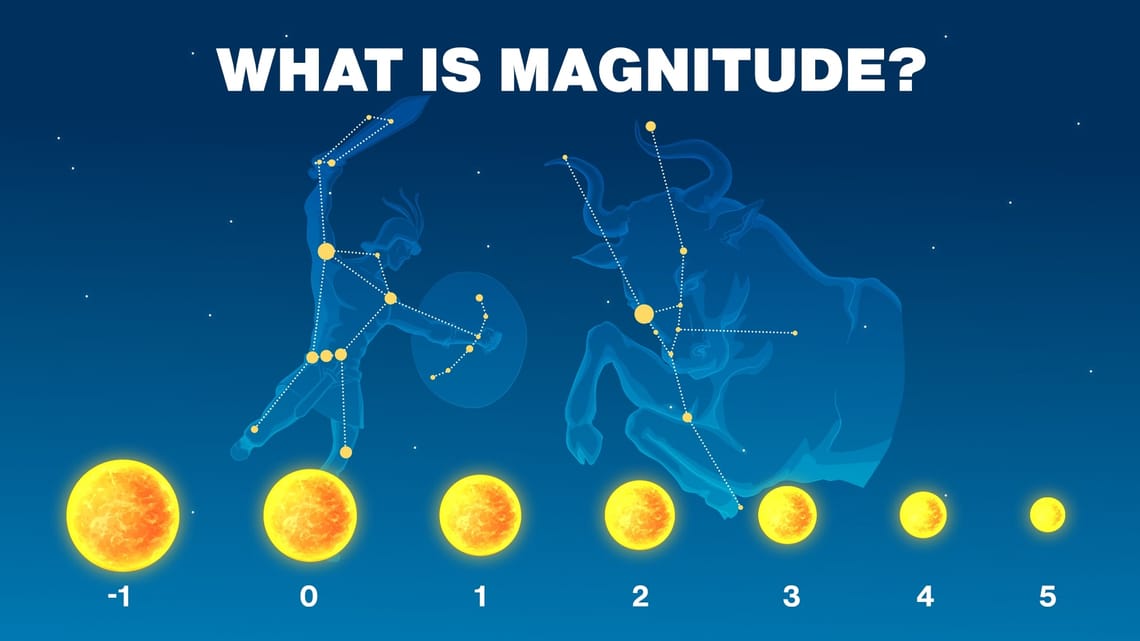
Astronomers rank stars by apparent magnitude, and this scale runs backwards. A brighter star has a smaller number, so Sirius sits at about -1.5 while a star at the limit of the naked eye sits near +6. Five steps on the scale correspond to a brightness factor of 100.
Sound engineers work in decibels, which compress a vast range of magnitudes into manageable numbers. An increase of 10 decibels is ten times the power, not ten units more of anything.
Units and Scales
A magnitude without a unit is not an answer. Length comes in metres, force in newtons, frequency in hertz, and all of them trace back to the SI base units. Write the number and the unit together, every time.
Watch out for logarithmic scales. Decibels, star magnitudes and earthquake magnitudes all compress their range, so a step of one is never a step of one in the underlying quantity.
Three Mistakes to Avoid
- Treating speed and velocity as the same thing. Speed is the magnitude. Velocity is the magnitude together with the direction.
- Adding vector magnitudes arithmetically. 3 and 4 at right angles give 5, not 7. Use Pythagoras.
- Reading a logarithmic scale as a linear one. A magnitude 6 earthquake is not twenty percent worse than a magnitude 5. It releases roughly 32 times the energy.
Magnitude is where every physics problem starts: get the size right, then decide whether the question also needs a direction. The other guides on the site pick up each quantity from there.
One Response
[…] than a footnote to it. A 1200 kg car at 20 m/s north and the same car at 20 m/s south have the same magnitude of momentum but opposite momentum […]